
Revitalising Our Congregations: A Strategy for Change
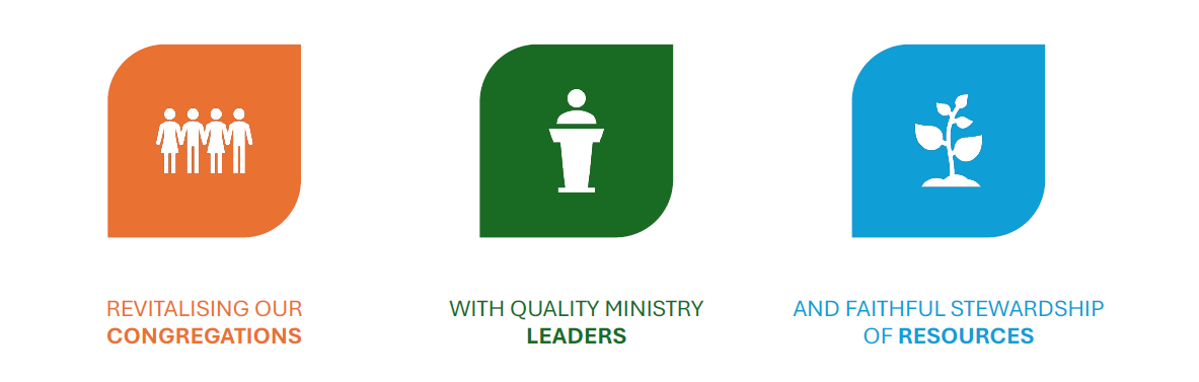
Revitalising our congregations through quality ministry leadership and faithful stewardship
This summary introduces Revitalising our congregations through quality ministry leadership and faithful stewardship of resources as a strategy for change at Synod Mission Services and Uniting Mission & Education.
The strategy was endorsed by the Synod Standing Committee in March 2026 to become a guiding principle for the Standing Committee and General Secretary as they:
- align the purpose and work of Synod Mission Services (SMS) and Uniting Mission & Education (UME) to the new reality of three larger, better resourced Presbyteries
- focus the commitment of SMS and UME toward the local church, and
- review SMS and UME so they are reshaped and financially sustainable for the future.
A strategy for change creates a clear guiding principle for decision-making. This is especially important when organisations face challenges. The Synod, along with the entire Uniting Church, must now address challenges that include the declining viability of many local churches, failing processes for placing and supporting ordained and lay ministers, and financial stress in every part of the church’s body.
A strategy for change will provide transparency during this time of review and renewal and, hopefully, preserve our unity by ensuring everyone can see why transformation is taking place. Nothing will be rushed. We are the Church and any changes will reflect our faith that Christ is our guide and our light.
A Strategy that reflects the Purpose of a Synod
We are familiar with the statement, ‘The Uniting Church is governed by a series of inter-related councils, each of which has its tasks and responsibilities in relation to both the Church and the world’ (Basis of Union, paragraph 15).
Yet those responsibilities have become tangled over time. To name just one example, Synod has increasingly taken on responsibilities for struggling Presbyteries. Now that our three new Presbyteries will be resourced to return to their core work, the Synod can do the same.
This prompts the question, what is the purpose of a Synod?
The Regulation that names the ‘Responsibilities of the Synod’ (3.1.5) has three sub-headings:
- Promotion and Encouragement of the Mission of the Church
- Theological and Ministerial Education
- Property
Like all councils, Synod ‘promotes and encourages the mission of the church’. This commitment may encompass a variety of mission-focused work, in collaboration with other councils. Yet the latter two responsibilities name Synod’s distinctive role, which is the preparation of ministry leaders and the stewardship of resources.
Revitalising our congregations through quality ministry leadership and faithful stewardship of resources is a strategy that returns the Synod to its core purpose.
A Strategy focused on the Church on the Ground
With ACT2 and 3P swirling, the significance of the Basis of Union’s statement that ‘the congregation is the embodiment in one place of the one holy catholic and apostolic church’ must not be lost. Our local churches and ministries are the primary way we embody the Gospel in the world. We must act to ensure their continuing viability.
Creating communities that invite people into Christian discipleship is the purpose for which God has called the church into being. Healthy local churches, well-resourced, well-located, and well-led, are crucial to the mission of the church. What is the Uniting Church’s future without healthy congregations?
Our commitment to ongoing reform and context-driven mission calls for a spacious understanding of that word ‘congregation’. It includes large and small traditional congregations, faith communities, the Mission Team’s work on blended ecology, diaconal ministries, and more.
Put simply, this strategy for change seeks to elevate the importance of the local church, in all its diversity. Or, as the Basis put it, to elevate the mission-significance of the local embodiment. Along with returning Synod to its intended purpose, this is a strategy designed to focus us all on that fundamental theological commitment of our Basis to the church on the ground.
A Strategy for the long-term
With this endorsed strategy to revitalise our congregations through quality ministry leadership and faithful stewardship of resources, the Synod Standing Committee, Synod Board, Synod leaders and SMS and UME sta^, with support from our colleagues in Uniting Financial Services, now have a shared purpose. We have a shared understanding of how we can best support Presbyteries and Congregations in this church of inter-related councils and responsibilities.
Implementing the strategy will complement the 3P Project and Future Directions. The reason we are moving to three new Presbyteries is to ensure a healthier future for congregations and local ministries. And the church on the ground is the very place we most desire to see the mission outcomes of Future Directions.
A strategy for change is not set in stone. It can be refined over time. However, it is held confidently and not abandoned lightly. This is a strategy for the long-term. Our future as Synod Mission Services and Uniting Mission and Education will be shaped by questions such as:
- How can Synod support the new Presbyteries and our Congregations so that, together, we are revitalising the local church?
- How can Synod work with Presbyteries and Congregations to grow the number of ordained and lay ministers serving the local church, and support them well?
- How can Synod support Presbyteries and Congregations to make the best missional use of the church’s property assets for future generations?
Revitalising our congregations through quality ministry leadership and faithful stewardship of resources is merely a set of words.
Yet words are powerful.
They can shape ideas and generate new forms of worship, witness and service. This set of words forms a strategy for change that, hopefully, will help us work with God to shape a strong future for the Uniting Church.